When cancer has spread, it’s common to be told that treatment is now ‘palliative’ and that chemotherapy is the only possible treatment. That’s not always the full story, because we can now precisely target and eradicate secondary tumours with an advanced radiotherapy treatment technique called SABR. It delivers a high dose of energy to tumours with millimetre precision, while keeping the surrounding normal tissues as safe as possible.
Stereotactic ablative radiotherapy (SABR) for metastatic cancer

A highly effective and non-invasive treatment for secondary tumours
SABR is not right for everyone, but for many people it can:
- Keep treated tumours controlled for many years
- Relieve or prevent symptoms more effectively than traditional radiotherapy
- Delay the need to start, or change, drug treatments like chemotherapy
- Achieve longterm remission without surgery
From my training at the Royal Marsden Hospital through to my pioneering NHS practice and my leadership role at GenesisCare, the UK’s leading private provider of SABR, I have a comprehensive range of experience in using this treatment technique to help over 1000 people with secondary cancer. This includes not just gastrointestinal cancers such as bowel, pancreatic and liver, but also breast cancer, lung cancer, prostate cancer, melanoma, and kidney cancer. My experience includes tumours in bone, spine, lung, liver, adrenal, lymph node and pancreas. I work with your existing NHS or private oncology team to coordinate treatment in a way that shoots for the best possible outcome, minimises side effects, and coordinates things carefully so you can focus on staying well.
Stereotactic radiotherapy is a quick, painless and non-invasive treatment that typically involves up to five visits to the clinic. There is no needle, anaesthetic, or overnight stay, and it doesn’t make you radioactive. Whilst it’s impossible to give guarantees, multiple clinical trials have shown that SABR is often as effective as surgery in eradicating secondary tumours. The aim is always the same: increase the chance of cure where that’s a realistic possibility, and otherwise extend life and maintain quality of life in a way that fits your priorities.
Why metastatic doesn’t always mean palliative
When cancer has spread, it’s easy to feel that the only options are wholebody treatments such as chemotherapy or focusing purely on symptom relief. In reality, there is an important middle ground.
Three concepts are particularly helpful:
- Oligometastatic disease
This means that only a small number of metastases (typically up to 5) are visible on CT, MRI or PET scan, and all are potentially treatable with SABR and/or other treatments like surgery. - Oligoprogression
This is when most of the cancer is under control on systemic treatment (chemotherapy, targeted drugs or immunotherapy), but a handful of areas are starting to grow or cause trouble. In this situation we use SABR to ‘zap’ the resistant areas while you stay on a treatment that is otherwise still working for you. - Strategic radiotherapy
This means treating tumours before symptoms develop, rather than waiting until pain or neurological problems appear. For example, treating high-risk but not yet symptomatic spinal metastases significantly reduces the chance of future spinal cord compression—a complication that can cause severe pain, loss of mobility and irreversible nerve damage. By stabilising these vulnerable areas early, strategic SABR helps preserve function, protects quality of life and avoids emergency treatments later. Stereotactic radiosurgery is also used to treat brain metastases, even if they’re not causing symptoms.
The big picture is very important in working out if SABR can help you. Some cancers are too widespread, or the tumours are too large or too close to other organs for SABR to be safe or worthwhile. My job is to be honest and clear about where SABR can add value – and where a different approach would be better. All the patients to whom I offer SABR are carefully reviewed in a multi-disciplinary team (MDT) meeting by a team with deep expertise, including radiologists and spinal surgeons, so you can be reassured that all recommendations are robust and ethically sound.
Here are a few clinical scenarios where I routinely use SABR:
- Eradicating single areas of oligometastatic disease in any organ a non-invasive option is preferable or necessary. Examples include a spinal metastasis in a patient with prostate cancer, a lung metastasis in someone with bowel cancer, or a lymph node in someone with ovarian cancer.
- Tackling multiple areas of active cancer confined to one organ, such as the liver or lung. While usually not curative, this can achieve disease remission and a prolonged break from the side effects of chemo.
- Dealing with oligoprogression in any organ when your usual oncologist wants to continue the current systemic cancer treatment, such as hormone therapy for breast cancer.
- Preserving quality of life when people have spinal tumours that aren’t currently causing problems, but look on the scan as though they’re likely to be problematic further down the line. Treating them early helps prevent a deterioration in symptoms.
- Treating painful spine metastases, where we have clinical trial evidence that delivering two SABR treatments is more effective than standard palliative radiotherapy in achieving long-lasting pain control. We offer a rapid access pathway across the 15 treatment centres in the GenesisCare network to minimise delays.
- Re-treatment of cancer in the pelvis in people who have already had radiotherapy, including rectal, anal, cervical and endometrial (uterine) cancer
If any of these sound like you, we can usually review your scans and let you know what might be possible within a week.

MRI-guided SABR for complex targets
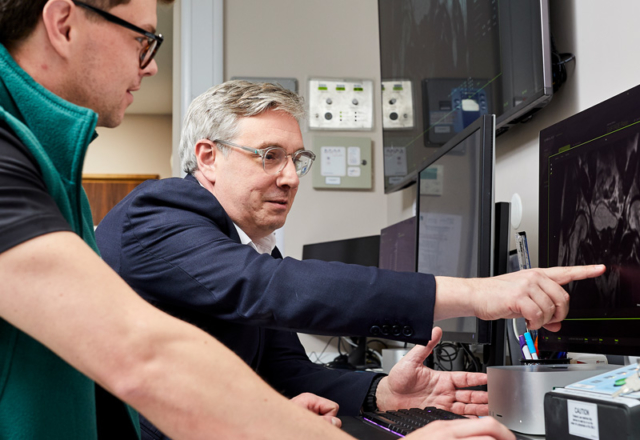
For many SABR treatments, CT-based image guidance is more than sufficient. However, some situations are particularly demanding. Examples include multiple liver metastases, lung tumours close to major airways and blood vessels, abdominal tumours close to the bowel or which move a lot with breathing, and treating parts of the body that have already received radiotherapy before (reirradiation). In these complex cases, I use MRI-guided radiotherapy, delivered on a specialised machine called an MRlinac. It allows us to see the tumour and nearby organs clearly during each treatment and adapt the plan there and then. I have lead the UK’s first comprehensive MR-linac service since 2019, pioneering several novel treatment pathways for people needing secondary cancer treatment.
MRI-guided radiotherapy offers several advantages:
- Better anatomical visualisation
MRI shows liver, lung and abdominal organs much more clearly than standard Xray images, helping us distinguish tumour from normal tissue even when they are close together. - Realtime imaging and motion management
We can monitor tumour movement as you breathe and use ‘gating’ so that the radiation beam is only delivered when the target is in exactly the right place. This is particularly valuable for abdominal and lung SABR, where tumours can move significantly with each breath. - Daily adaptive planning
With adaptive radiotherapy, we adjust the treatment plan on the day to account for changes in the tumour or nearby organs. This allows us to deliver a higher dose than conventional radiotherapy while respecting strict safety limits for sensitive organs.
Together, these features can make a meaningful difference when the anatomy is complex or when there are multiple tumours to treat.
The team I lead at GenesisCare has pioneered this technique in the UK and has more experience than any other centre in using it to offer the best possible SABR to people who would benefit from it.
How does SABR work?
With stereotactic ablative radiotherapy (SABR), also known as stereotactic body radiation therapy (SBRT), we leverage advanced technology to focus the energy in X-rays on secondary tumours, leading to their eradication (‘ablation’). The cancer cells are pushed beyond their ability to repair themselves, while the surrounding normal tissue mostly can. The radiation causes breaks in the DNA of cancer cells and also damages the small blood vessels feeding the tumour, so over time the treated area tends to shrink, scar and lose its blood supply. Because SABR is given in just a few, powerful treatments, each dose is biologically much more intense than standard radiotherapy, which increases the chance of completely inactivating those targeted cancer cells. There’s also growing evidence that killing tumour cells in this focused, high-energy way can alert the immune system to their presence, sometimes helping your own defences recognise and attack cancer elsewhere in the body. I’m involved in developing clinical trials looking to leverage this interaction further.
The SABR treatment process
Although the planning behind SABR is complex, your experience with us is straightforward. Here’s the process you can expect:
- At your first treatment appointment, we start with detailed planning scans to map the tumour and nearby organs with millimetre accuracy.
- You may be positioned on the treatment couch in a custom body-mould so we can reproduce the same posture for every session.
- Our team designs a highly focused radiotherapy plan, shaping the dose tightly around the tumour while protecting healthy tissue.
- During each treatment session, the radiographer team uses sophisticated imaging to ensure everything is aligned perfectly.
- The treatment itself is painless—the machine moves around you while you simply lie still and breathe normally, or holding your breath when asked.
CT-guided SABR typically takes 10-30 minutes per session. MRI-guided SABR can take up to an hour per session. Some people worry about claustrophobia, but the treatment team can help with that when you attend for your scans. Don’t let it put you off!
Side effects and safety: what to expect
Most people experience some mild and short-lived side effects during and immediately after treatment. It’s almost always a lot easier than chemo! Short term side effects depends on which part of the body is being treated.
Before treatment we will go through the specific side effects relevant to your situation. During and after treatment we encourage you to contact us promptly if anything feels different, even if you are not sure it is related.
| Site | Fatigue | Nausea | Diarrhoea | Breathlessness | Pain |
|---|---|---|---|---|---|
| Lung | one/3 | one/3 | one/3 | two/3 | two/3 |
| Liver | three/3 | three/3 | two/3 | -- | one/3 |
| Bone | one/3 | two/3 | one/3 | -- | two/3 |
| Spine | one/3 | two/3 | two/3 | -- | two/3 |
| Node | two/3 | two/3 | two/3 | -- | one/3 |
| Internal | two/3 | two/3 | one/3 | -- | one/3 |
Site
Fatigue
Nausea
Diarrhoea
Breathlessness
Pain
Lung
one/3
one/3
one/3
two/3
two/3
Liver
three/3
three/3
two/3
--
one/3
Bone
one/3
two/3
one/3
--
two/3
Spine
one/3
two/3
two/3
--
two/3
Node
two/3
two/3
two/3
--
one/3
Internal
two/3
two/3
one/3
--
one/3
Having SABR privately with my team
Safe and effective SABR is about coordination and experience as much as the technology itself. As a consultant clinical oncologist and SABR specialist, I offer treatment that follows international best practice. The focus is on what’s in your best interest, rather than being constrained by NHS funding criteria. With my team you can expect:
- Joined up care and MDT support
Close collaboration with surgeons, medical oncologists, liver specialists, gastroenterologists and palliative care specialists as needed. - Technical expertise
Access to modern imageguided radiotherapy platforms – including MRIguided options and CyberKnife for complex cases – and a physics team experienced in complex liver, lung, node and spine SABR. - Personal supervision
I remain closely involved throughout – reviewing scans, supervising planning, and adjusting treatment in the context of your wider care. - Supportive environment
A calm treatment setting with radiographers used to caring for people undergoing SABR treatment and systemic cancer treatments. - Clear information
I explain the treatment options, side effects and logistics in plain language, and provide documentation you can share with family, GP and other specialists.
Frequently asked questions
This simply means that the delivery of radiation to the tumour(s) is guided in three-dimensional space with extreme precision. The word comes from “stereo” (three-dimensional) and “tactic” (to arrange or target). In image-guided radiation therapy, it refers to techniques that use detailed imaging and careful positioning to deliver energy to a tumour with millimetre-level accuracy, while avoiding the surrounding normal tissues as much as possible. A whole radiotherapy team comes together to deliver it safely.
We look at the whole picture: cancer type, stage, the number and location of metastases, your general health, and other treatment options. I will explain whether SABR is strongly recommended, a possible option, or not advisable – and why – so you can make an informed decision.
Often, yes – SABR is frequently used when there are several lesions, provided the overall number and total volume are within safe limits. Sometimes we combine SABR to some tumours with surgery or systemic therapy. The exact threshold depends on multiple factors rather than a simple ‘onesizefitsall’ rule.
In some cases we can treat new areas with SABR, particularly if they are in different parts of the body or enough time has passed. Retreating the same area is more complex and depends heavily on the doses you have already received. MRIguided, adaptive SABR is often particularly helpful in this setting.
For some people with oligometastatic disease – especially certain bowel cancer scenarios – SABR may form part of a strategy with curative intent. When there is more widespread disease, the realistic aim is to control treated areas for as long as possible, relieve symptoms and prolong good quality life.
Many people continue working during and after SABR. Treatment sessions are short and given on an outpatient basis. We will advise on any limitations (for example heavy lifting after spine treatment, or travel plans that might clash with followup scans), but in general SABR is compatible with day-to-day life.
Very often the answer is ‘yes’. Reirradiation is possible in certain circumstances but requires very careful review of your previous treatment details and dose distributions. It is not always safe, but it is not automatically ruled out either. MRI-guided adaptive SABR often expands what we can safely offer in some reirradiation cases.
Either is absolutely fine. Many people are referred by their oncologist or surgeon; others contact my office directly. We can help gather scans and reports so that I have everything I need to give a thoughtful opinion.
No. Many people who come to see me decide to self-fund their treatment and then return to NHS care. We ensure that pricing is transparent and the transition between teams is seamless. Asking me to review your case and discuss options with you doesn’t commit you to anything.
Ready to start?
If this treatment is part of your treatment plan, we will act quickly to get things moving. From initial consultation to your first cycle, my aim is clear: to provide fast, safe, and effective care grounded in the latest science, delivered with genuine compassion.
Whether your goal is cure, control, or comfort, we’re ready to support you every step of the way.