
Using advanced technology to achieve better outcomes

Advanced pancreatic cancer can be a difficult disease, both because of where the pancreas sits — deep in the abdomen, surrounded by the stomach, bowel, liver and major blood vessels — and because many tumours are discovered at a stage where upfront surgery is not possible. Nevertheless, there are grounds for the cautious optimism that pancreatic cancer patients deserve, because treatments are improving all the time. One of the most important advances is MRI-guided SABR (stereotactic ablative radiotherapy): a highly precise, non-invasive treatment that uses real-time MRI imaging to target pancreatic tumours with millimetre accuracy.

SABR is transforming what is possible for people with every stage of pancreatic adenocarcinoma. It gives high rates of tumour control combined with excellent tolerability and the potential to extend life expectancy while preserving quality of life. At GenesisCare, the MRI-guided SABR service that I lead delivers this treatment using state-of-the-art MR-linac technology, allowing us to adapt the treatment each day and safely achieve higher doses than previously possible.

For patients with metastatic pancreatic cancer that has spread to other organs, SABR can also be useful treatment option. If there are up to five secondary tumours, carefully targeted ablative doses of radiation can often be used to eradicate them all. Whilst this isn’t a curative treatment, it can prolong the amount of time it takes for the cancer to get worse overall (what we call ‘disease progression’), and can also give a break from chemotherapy, which improves quality of life.

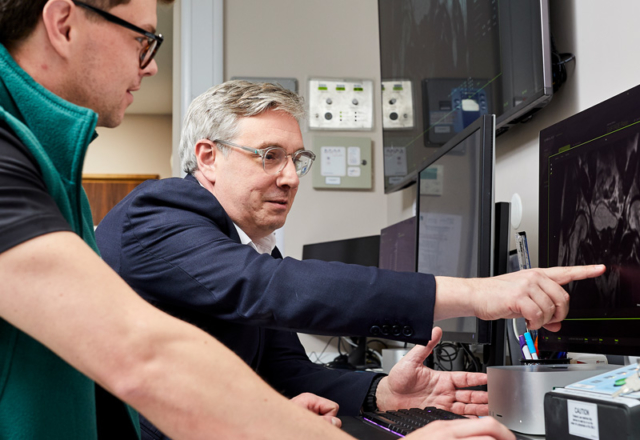
I have extensive experience of using advanced radiation therapy techniques to treat:

  • Unresectable pancreatic cancer. Radiotherapy is used after or instead of chemotherapy to treat locally advanced disease – this includes both SABR and chemoradiotherapy.
  • Borderline resectable tumours. Neoadjuvant (pre-operative) chemotherapy and radiotherapy can be used before attempted pancreatic resection surgery, in collaboration with surgical teams in Birmingham and London.
  • Recurrent disease. SABR can eradicate a small area of cancer that grows back after a Whipples surgical resection where the tumour used to be.
  • Resectable pancreatic cancer. In older people, or those with medical conditions where surgery would be too invasive and where chemotherapy treatment would be too hard on the body, radiotherapy controls tumour growth very well.
  • Symptomatic tumours causing pain and other problems. Palliative radiotherapy and coeliac plexus radiosurgery can be used to help with unpleasant symptoms.
  • Oligometastatic pancreatic cancer. When there is limited spread to other organs, SABR can eradicate secondary tumours and help delay disease progression.

Your case is always carefully assessed by a multidisciplinary team (MDT) including expert radiologists, other oncologists, and surgeons where needed. We consider all options including SABR, preoperative chemoradiation, and palliative radiotherapy.

If you’re exploring private pancreatic cancer treatment options, MRI-guided SABR represents a powerful and evidence-based addition to chemotherapy and surgery — and, for some, an option that keeps the disease controlled for longer than expected.

Why MRI-guided SABR is important in pancreatic cancer

SABR (which is also referred to as stereotactic body radiation therapy, or SBRT) leverages advanced technology to focus the energy in X-rays on tumours, leading to their eradication (‘ablation’). The cancer cells are pushed beyond their ability to repair themselves, while the surrounding normal tissue mostly can. The radiation causes breaks in the DNA of pancreatic cancer cells and also damages the small blood vessels feeding the tumour, so over time the treated area tends to shrink, scar and lose its blood supply. Because SABR is given in just a few, powerful treatments, each dose is biologically much more intense than standard radiotherapy, which increases the chance of completely inactivating the targeted cancer cells. There’s also growing evidence that killing tumour cells in this focused, high-energy way can alert the immune system to their presence, sometimes helping your own defences recognise and attack cancer elsewhere in the body.

When it comes to pancreatic cancer,  the innovation comes when SABR is combined with MRI-guidance. The pancreas and surrounding organs move constantly as you breathe, digest, or even shift slightly on the treatment couch. The tumour often sits just millimetres from the stomach, bowel, duodenum, kidneys and bile duct. Delivering enough energy to control the tumour without harming these structures has historically been difficult. CT-guided radiotherapy cannot track this movement accurately enough to safely increase radiation dose. In fact, we often have to reduce the dose received by much of the tumour to prevent damage to normal tissues, and this can reduce overall effectiveness.

MRI-guided SABR addresses this problem by providing:

  • Better anatomical visualisation
    MRI shows abdominal organs much more clearly than standard CT images, helping us distinguish tumour from normal tissue even when they are close together.
  • Realtime imaging and motion management
    We can monitor tumour movement as you breathe and use ‘gating’ so that the radiation beam is only delivered when the target is in exactly the right place. This is particularly valuable for abdominal SABR, where tumours can move significantly with each breath.
  • Daily adaptive planning
    With adaptive radiotherapy, we adjust the treatment plan on the day to account for changes in the tumour or nearby organs. This allows us to deliver a higher dose than conventional radiotherapy while respecting strict safety limits for sensitive organs.

Together, these features make it possible to deliver a higher radiation dose to more of the tumour than is possible on any other radiotherapy machine, and clinical trial data shows that this can translate into patient benefit.

Clinical outcomes: what the research shows

Low-dose SABR analysis
A large scientific review process (‘meta-analysis’) comparing low dose SABR with conventional radiotherapy showed that SABR was associated with significantly improved survival at two years (26.9% vs 13.7%) and lower rates of acute severe side effects (5.6% vs 37.7%).

High-dose MRI-guided SABR trial
Clinical trials and other studies have shown that by using the improved precision of MRI-guidance to deliver higher doses, survival at two years higher at around 50%.

GenesisCare UK MRI-guided SABR experience
My team published our own outcomes using MRI-guidance to deliver a slightly lower dose than used in the trial above, with similar results. A more recent analysis, where we give the full dose, has shown improved tumour control and life expectancy after treatment. 

EXTEND trial
This randomised trial showed that treating oligometastatic pancreatic cancer more aggressively than just giving chemo, including the use of SABR, delayed the time if took for the cancer to progress from 2.5 months in the group that got chemo alone to 10.3 months in the group treated more pro-actively.

How MRI-guided SABR compares with IRE

Some hospitals offer IRE (irreversible electroporation) — a technique that uses electrical pulses to punch holes in tumour cells. While IRE has a role in selected patients, it has important limitations:

  • Non-invasive: SABR requires no incisions, needles or anaesthetic. In the CROSSFIRE trial comparing IRE with SABR, general anaesthesia was required and most people needed three days in hospital after treatment.
  • Complications: In the same trial, one in five (22%) patients had a severe complication of IRE whereas this happened in only 6% of the SABR group.
  • Predictable: SABR delivers carefully planned treatment across the whole tumour and areas at risk of microscopic spread, whereas IRE results vary depending on electrode placement.
  • Evidence base: Published studies on IRE show mixed results, whereas MRI-guided SABR has consistently demonstrated high rates of tumour control with low toxicity.

The treatment process

Although the planning behind MRI-guided SABR is complex, your experience with us is straightforward. Here’s the process you can expect:

  • At your first treatment appointment, we start with a detailed CT scan and MRI to map the tumour and nearby organs with millimetre accuracy.
  • You are positioned on the treatment couch so we can reproduce the same posture for every session.
  • The GenesisCare team designs a highly focused radiotherapy plan, shaping the dose tightly around the tumour while protecting healthy tissue.
  • During each treatment session, a consultant oncologist reviews the daily scan and makes any adjustments needed with reference to my initial treatment plan.
  • You regulate your breathing during treatment via visual instructions from the machine. The whole process takes around 45 minutes.

Some people worry about claustrophobia, but the treatment team can help with that when you attend for your scans. Don’t let it put you off!

Integrating SABR with systemic therapy and other treatments

SABR is usually used in conjunction with other treatments such as chemotherapy and targeted therapy. It’s important to get the timing right and to make sure everyone is in agreement with the proposed treatment plan, so I work closely with your usual team to make sure that everything is joined up. If surgery is part of the plan, timing is also critical and your case will be reviewed in a multidisciplinary meeting to make sure everything is coordinated properly.

Side effects: what you may experience

Most people tolerate MRI-guided SABR well.

Common short-term effects

  • Tiredness
  • Nausea or mild abdominal discomfort
  • Bloating or changes in appetite

Less common

  • Loose stools or bowel irritation
  • Low-grade fever
  • Temporary flare of pain

Rare but possible

  • Stomach or duodenal ulceration
  • Bleeding
  • Pancreatitis

Daily MRI guidance significantly reduces these risks by adjusting each treatment to the day’s anatomy.

The advantages of private treatment with me

There are many benefits to private care

  • Unrivalled expertise and clear, compassionate communication
  • Consultation and full MDT review within a week
  • Rapid access treatment pathway for insured and self-pay patients
  • Coordinated care with your surgeon or chemotherapy team

Frequently asked questions

Suitability depends on tumour size, location, surrounding anatomy and overall health. A consultation and imaging review can determine this quickly.

If it’s not safe for you to have an MRI for any reason, we can still offer SABR using CT-guidance. I will discuss this in detail with you during our consultation if it applies to you.

Pancreatic cancer is always at high risk of spreading to other organs, and this means that very sadly, many people are not cured even when the cancer is localised. Nevertheless, with SABR there is a significant benefit to long-term tumour control.

Sometimes, and especially with borderline resectable cases, SABR shrinks the tumour enough to allow surgery. I have experience of working with surgeons who are happy to take on these complex cases, and careful coordination of the pathway is absolutely crucial.

In most cases, yes—if you really want to! Many patients continue daily activities throughout.

Follow-up scans are typically done 2–3 months after treatment, with regular monitoring thereafter. It takes many months to see the full effect of treatment as pancreatic tumours often shrink quite slowly to both systemic therapy and radiotherapy.

The Pancreatic Cancer UK website is an excellent resource if you want more information about surgery, nutrition, symptom control and access to supportive care services.

Clinical trials have yet to show a benefit for proton therapy over other forms of radiotherapy for pancreatic cancer. There may be advantages for some people needing treatment after previous radiotherapy.

This is a robotic radiotherapy machine that I use regularly at HCA Harborne hospital. The disadvantage it has for tumours that move with breathing is that it requires an invasive procedure to implant a gold marker inside the tumour—but this only enables us to track the tumour, not the normal tissue. CyberKnife is an excellent treatment for brain and spinal tumours, but for moving targets, I believe that MRI-guidance is now the preferred option.

If you or a loved one has been diagnosed with pancreatic cancer and want to explore advanced, evidence-based treatment options, MRI-guided SABR may be worth looking at. I can review your scans, clarify your options and build a personalised plan — quickly, clearly, and with the full support of our expert GenesisCare team.

Ready to start?

If this treatment is part of your treatment plan, we will act quickly to get things moving. From initial consultation to your first cycle, my aim is clear: to provide fast, safe, and effective care grounded in the latest science, delivered with genuine compassion.

Whether your goal is cure, control, or comfort, we’re ready to support you every step of the way.

"*" indicates required fields

Privacy*